Bicentennial of the Bolivarian Congress of the People
 Print This By Arturo Rosales writes from Caracas – Axis of Logic Exclusive
Axis of Logic exclusive
Thursday, Feb 25, 2021
Introduction
This year, 2021, is the 200th anniversary of the decisive battle of the war of independence that liberated Venezuela from 300 years of colonial rule by the Spanish Empire. The iconic date was 24 June 1821 and occurred on the battlefield at Carabobo, in the state of the same name.
It is fitting that this year’s Bolivarian Congress of the People should be named the Bicentennial Congress and President Maduro has launched an initiative to discuss and implement all aspects of Venezuela’s national life to shore-up and consolidate the framework of the revolution and continue paving the way towards a socialist society run by the people in the context of participatory, direct democracy.
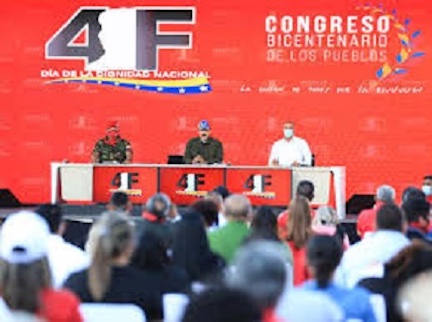
The Plenary Congress will take place on 27 February where proposals will be heard from all corners of the country to set up a democratically voted agenda. In the past two weeks, local Bolivarian Congresses have been taking place in all 23 states and the capital district to prepare proposals and initiative for 27 February. So, the agenda is being built from bottom up and not imposed top-down by representative elites as in the case in countries still being governed by false, bourgeois-based democracies.
The all-encompassing reach of the agenda was summed up by President Maduro in a national broadcast: “We visualize working on two levels – facing the challenges of the present in a concrete way to help solve the needs of the population; this will be followed by a program to advance towards 2030 with a view to constructing socialism in territorial, economic, moral, productive, political, social, ideological, national and international terms”.
Background
In 2007, Comandante Chávez, with his immense strategic vision, presented a project to reform the Bolivarian Constitution that sought to deepen popular power. The project was approved and sanctioned by the National Assembly but when submitted to a popular referendum after an intense and brutal media campaign against it, the comandante’s proposal unfortunately lost by a very few votes and became his first and only electoral defeat.
This project approved in the National Assembly was to strengthen legal regulations in laws such as the "law of local public planning councils" that determines that popular power is expressed by constituting the communities, communes and self-government of cities, through communal councils, councils of workers, councils of peasants, students, fishermen, women, people with disabilities, senior citizens, sports and other forms of community organization. The deepening desired by Chávez was slowed, among other things, by the loss of the referendum and by the usual armchair revolutionaries and bureaucrats who want everything to change but only so that everything remains the same.
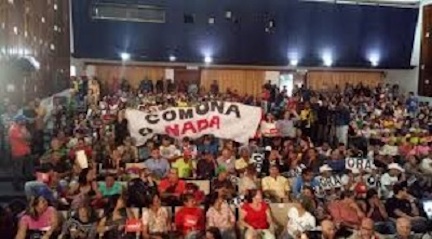
President Maduro has taken up Chávez's thinking so that he focused the entire strategy of popular power on socio-productive organizations, community councils and communes. "Commune or nothing" was the command to redirect and consolidate the course of the revolution.
Preparations for the Bicentennial Congress of the People
The coming days are a unique opportunity to exponentially accelerate the deepening of popular power. The II Communes Congress recently came to an end and is an event that can only happen in revolution.
Proposals were put forward there, which must now be discussed at full level, in the National Assembly and citizens’ assemblies, in the communal councils, in factories and workplaces because - in a state constitutionally governed by participatory (as opposed to representative) democracy - the laws, policies and changes needed must be a a creation of and approved by the people - changes that, among many other things, must focus on the territorial political structure of Venezuela. We must begin to build the new geometry of popular power.
We applaud the creation and advancement of the University of the Communes. Let us remember that one of the 5 engines that Chávez wanted to promote in 2007 was a powerful campaign of moral, economic, and political education that went beyond schools and that extended to the countryside, factories and of course to communal councils and communes.
Reflections on current obstacles in Venezuela
One of the biggest problems is the lack of training of citizens in general, especially in the administration, accountability, and effective implementation of social controls. Therefore, a campaign of education, information, and permanent accompaniment with effective technical advice according to the activities and needs of the people is more necessary than ever. It is the catalyst required to achieve a political culture of citizen participation based on ethics, honesty, and solidarity.
There is no shortage of those who see in the organization of communal councils and communes an opportunity to obtain resources for their own benefit or simply acquire credentials to become a "career politician" and advance their individualistic projects. Combatting centuries of colonialism, looting and transculturization is not an easy task, it will take a lot of effort and much more patience. In addition, transformation must begin at home, with oneself as the main protagonist. Many who see themselves as, and feel "revolutionary", get up thinking about what brand of toothpaste to use, what trendy gear to wear, what new fashionable haircut to have which will look good in selfies. We all live immersed in it and have been “captured” and hardly realize how we have been deeply and very subtly poisoned with this heinous culture that pervades social media.
"Selfishness is good and greed is better" is preached to us by the high priests of neoliberalism. It is one step further than Gordon Gecko's “greed is good”. Their dogmas are unwavering laws, and it is difficult to try and think differently. This cultural machinery for, in Chomsky's words, "building consensus" remains highly effective and permanently continues to create a mass of people with no ability to think critically. A vast majority of human beings are without consciousness, totally numb and addicted to the opium of this new religion.
Corruption, cronyism and clientelism, consumerism, easy living and other vices that are intrinsically capitalist continue to deface society as in any other capitalist country. Venezuela remains, despite the efforts of many honest people and the many changes achieved by the revolution, a capitalist country that still suffers from many of the evils engendered by capitalism, especially in its neoliberal incarnation. These are evils that some ironically defend and even want to make us think that they are unchanging, eternal and something natural in human beings. Thus, unfortunately we continue to see another mayor or governor, public officials of all kinds and even some spokespeople who repeat the old vices so common in the IV Republic and end up in discussing deals with corrupt businessmen and bankers.
At this point it needs clarifying that because of the ongoing sanctions and blockade of the country and many of its institutions to which Venezuela is being subjected, it is often more than necessary for mayors, governors, and the state at large, to form alliances with entrepreneurs, both national and international, who believe and are willing to invest in Venezuela. In such cases, transparency of the authorities and social controls are necessary to make these alliances hugely beneficial to the people in general.
The so-called "inefficiency" and many of the acts of corruption are really acts of treason. Sabotage of state businesses has become very profitable for those in disguise who betray their people for a few more dollars. Almost always after committing their misdeeds they run happily to take refuge in the home of our main enemies, feeding the stolen money to the voracious jaws of international banking and its mobsters.
Young people who have gradually been awakening their social conscience, solidarity and love for the homeland, humanity and the planet can help accelerate the necessary changes that are undoubtedly to come. As the Liberator himself said: "Moral and lights are our primary needs" but today much more than yesterday.
Aims of the Bicentennial Congress
On 27 February, when we commemorate the first popular uprising against neoliberalism - an uprising in Caracas in 1989, better known as the Caracazo, and which was the spark that ignited the revolutionary flame that continues to burn harder today than ever before - the social movements, artists, students, workers, people from the communes can raise the projects necessary to "change everything that needs to be changed", and that the authorities in the National Assembly will live up to the challenge.
2021 is 200 years after the final defeat of the Spanish Empire in Venezuela on 24 June 1821 at the Battle of Carabobo, so this year’s Bolivarian Congress of the People aptly renamed Bicentennial for historical reasons and references, will be vital to strengthen the popular power of the Venezuelan people on their own destiny and organization of their country. The constitutional framework for this transformation exists in the Preamble to the 1999 Constitution passed by 72% of voters in a national referendum.
Global change is afoot
Although many do not want to accept it, the world system in which we live is at a breaking point, so much so that even the gang of plutocrats who believe themselves owners of the planet have accepted this reality and are preparing for what they, at their last meeting in Davos, defined as the great "reset" of capitalism to try to fix what is no longer fixable. In these times of structural crisis, a small personal effort towards change can have unpredictable effects. So who can say what the combined effort of the citizens of a country like Venezuela might have, that two hundred years ago expelled the most powerful empire of the time from the continent.
What is happening here may be the decisive weight that tips the scales towards the new world, a world of peace and justice, a world where many worlds fit. The other possibility is that oligarchies will get away with it and build something much worse than we already have. An authoritarian and truly dictatorial world system. A neo-feudalism governed by elites and their corporations at the height of violence, repression and total derecognize the timid and weak laws that now govern international relations.
Today we are all obliged - whether we want to or not - to make a moral and ethical decision and that decision, even if many do not believe it, depends on the creation of the world we want to leave to our children and grandchildren.
It is no longer left or right, nor liberal or conservative, nor communism or radical anarchism. The Bicentennial of the Bolivarian Congress of the People will contribute to that change and today, as Martí said, the choice is between those who love and build or those who hate and destroy. Which side are you on?
Sources: Venezuelan National Radio (RNV); National Presidential Broadcasts; La Iguana TV; La Hojila; Misión Verdad
© Copyright 2021 by AxisofLogic.com
This material is available for republication as long as reprints include verbatim copy of the article in its entirety, respecting its integrity. Reprints must cite the author and Axis of Logic as the original source including a "live link" to the article. Thank you!
|
 Print This

|